SEARCH
Your address will show here +12 34 56 78
CJC-F, CJC-F Announcements, CJC-F Understanding Forensics, CLD Criminal Law Basics, Uncategorized

INTRODUCTION


In the previous article “Singapore’s Misuse of Drugs Act – A Primer” (https://nuscriminaljustice.com/singapore-misuse…ugs-act-a-primer/), the basic statutory rules governing certain offences set out in the Misuse of Drugs Act, that of possession, consumption, trafficking and importation, were summarized. This article seeks to briefly summarise how the Court uses the sentencing ranges, referred to in the previous article, to sentence an offender.


In this regard, the Courts have developed certain sentencing frameworks for certain drugs, so that both the Prosecution and the accused person would know what ought to be the rough estimate of the  sentencing range that an accused person would be liable to.

There is a large variety of drugs that are present in the world. Thus, not all the frameworks that have been established by the Courts will be covered here. Further, the Courts have not set out sentencing frameworks for all the drugs as not all the drugs have involved a conviction in a Court of law. Even if there are such convictions, they do not occur often enough to warrant a sentencing framework for that particular drug.

For the avoidance of doubt, the frameworks set out below concern that of trafficking of three drugs, namely diamorphine, cannabis and methamphetamine. This is because they are relatively common in occurrence, alongside consumption which is governed by the MDA. In addition, among the four offences discussed in the previous article, trafficking is the one which has the most substantial case law.

This article is written with the idea of introducing readers the basic rules and laws surrounding judicial frameworks.



Source: https://www.lawcrossing.com/images/articleimages/Legal-Writing-Guidelines-for-Law-Students-and-Attorneys.jpg


UNDERLYING RULE INVOLVING FRAMEWORKS 


Before going into the specific sentencing frameworks, one must always consider the rule set out in the case of Dinesh Singh Bhatia s/o Amarjeet Singh v PP (“Dinesh Singh Bhatia”) where the High Court explicitly stated that sentencing frameworks help to achieve a certain degree of “consistency and rationality in our sentencing practices.” However, the Court warned that such sentencing practices “ought not, however, to be applied rigidly or religiously” as “[n]o two cases can or will ever be completely identical or symmetrical.”

Thus, one should always note that no sentencing framework is ever to be applied rigidly. An accused person may be sentenced to a term of imprisonment that is far higher or lower than the prescribed band/tier (as will be set out below). This is due to the existence of several aggravating or mitigating factors that may be in existence, such as, possibly, where the profit that a drug offender may obtain from his activities is particularly lucrative or where there is an early plea of guilt by the accused. 


Thus, one should always remember that the sentencing frameworks set out by the Courts are not set in stone.


THE DETERMINATION OF FRAMEWORKS


The following section will briefly cover some of the sentencing frameworks that have been with regard to the offence of trafficking. Note that this also includes instances of possession with the purposes of trafficking. 


As a preliminary point, several things must always be considered when it comes to the sentencing of a trafficking charge. First, the starting point would naturally be the quantity of drugs that was involved in the trafficking charge. As explained in the seminal case of
Vasentha d/o Joseph v PP (“Vasentha”), the quantity of drugs, as measured in terms of its net weight, that has been trafficked would have a direct correlation with the degree of harm to society. However, other factors must also be considered such as the culpability of the offender and the presence of aggravating or mitigating factors.

This was also supported by the Court of Appeal in Suventher Shanmugam v PP where the Court emphasised that the sentence passed for a crime should be proportional to the gravity of the offence. For offences concerning the trafficking and importation of drugs, the gravity of the offence is measured by the quantity of drugs involved. Second, when determining what ought to be the appropriate indicative starting point of an offence, the Court in Vasentha took into account three considerations.

First, the maximum sentence is usually reserved for the “worse type of cases falling within the prohibition” and the courts would impose a sentence close to or fixed at the statutory maximum only if the offender’s conduct is “among the worst conceivable for that offence, citing the cases of Angliss Singapore Pte Ltd v PP and Sim Gek Yong v PP. The sentence must correspond to the seriousness of the offence and that requires an examination of not only the harm but also the culpability of the offender and other relevant circumstances. The starting points should thus leave room for the sentencing judge to adjust the sentence upwards or downwards where required.

Secondly, the cases ought to fully utilise the full spectrum of possible sentences, and thus, the indicative starting points ought to span a range of possible sentences that stop short of the statutory maximum sentence. For the present purposes, this would mean the sentences set out in the Second Schedule of the MDA. Lastly, due to the importance of the degree of harm as a sentencing consideration, the starting points should be broadly proportional to the quantity of the diamorphine. In other words, the greater the quantity, the higher the sentence.


Source: https://ars.els-cdn.com/content/image/3-s2.0-B978012800213100081X-f81-01-9780128002131.jpg


TRAFFICKING OF DIAMORPHINE 


The first offence is that of trafficking of diamorphine. If an offender is carrying between 10 and 15 grammes of diamorphine, the statutory sentencing range of a minimum of 20 years imprisonment and a maximum of 30 years imprisonment, or life, along with 15 strokes of the cane, would be applicable to him.


What would then be the sentencing range if the offender is in possession of less than 10 grammes instead? This is explained in the above mentioned case of Vasentha, where the High Court set out the indicative starting points for first-time offenders who are trafficking in diamorphine, which has been banded according to the quantity:
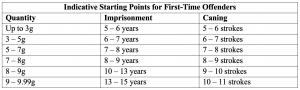

The Court further explained that these are just indicative starting points, based on the quantity of the diamorphine. The second step of the determination would involve calculating and adjusting the amounts, where appropriate, to reflect the offender’s culpability along with the presence of any relevant aggravating or mitigating factors. Where no adjustment is necessary, the indicative starting point may then be the appropriate sentence to be imposed.

For cases where the offender is instead in possession of diamorphine that is greater than 9.99g, guidance can be obtained from the case of PP v Tan Lye Heng (“Tan Lye Heng”) where the Court set out the following indicative starting points for the custodial sentence for trafficking between 10g to 15g of diamorphine:



The offender would also be sentenced to the mandatory 15 strokes of the cane, as per the Second Schedule of the MDA.

The above concerns first-time traffickers of diamorphine. The exact same starting points cannot automatically apply for repeat offenders of trafficking, as explained in the case of PP v Lai Teck Guan (“Lai Teck Guan”). The Court explained that whether the principles of Vasentha are suitable for any given offence is dependent on whether the sentence hinged largely on a single metric, albeit later adjusted for other factors, or whether the gravity of the offence was or might have been affected by several metrics, each potentially of importance.

In cases of repeat offenders, Vasentha is not suitable as there were two important metrics that would feature in the sentencing analysis; the quantity of drugs and the circumstances in which the repeat offence came about. It is also difficult to derive a principled uplift from Vasentha, for repeat offenders, as the sentencing ranges for first-time offenders and repeat offenders do not mirror each other.

However, Vasentha is still useful and applicable when sentencing repeat offenders in the following way:

The sentencing court would first derive the starting point for the sentence based on the quantity of drugs for first-time offenders using Vasentha.

However, Vasentha is still useful and applicable when sentencing repeat offenders in the following way: 

  1. The sentencing court would first derive the starting point for the sentence based on the quantity of drugs for first-time offenders using Vasentha
  2. The Court would then apply an indicative uplift on account of the fact that this is a repeat offence and derive an indicative starting point on this basis, having due regard to the circumstances of the repeat offence. 
  3. Finally, the court would adjust that indicative starting point based on the offender’s culpability and the aggravating or mitigating factors, which have not been taken into account in the analysis up to this point.

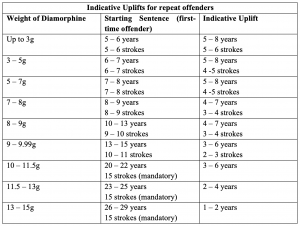
With the above in mind, the Court then set out the following indicative uplifts, after taking into account the starting points set out in Vasentha and Tan Lye Heng above:


However, the abovementioned starting points were revised by the High Court in
Soh Qiu Xia Katty v PP (“Katty Soh”):
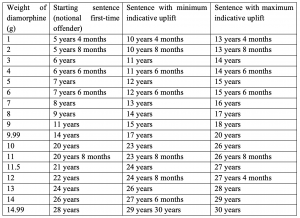


The caning sentences was also revised, as follows:
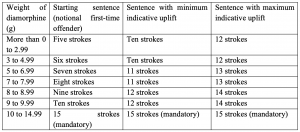


At this juncture, it is pertinent to note that all 3 of the decisions in
Vasentha, Lai Teck Guan and Katty Soh were decided at the High Court level. As such, none of the cases overrule one another. The revisions made in Katty Soh from the decision made in Lai Teck Guan were referred to by the High Court in Mohd Akebal s/o Ghulam Jilani v PP where the Court made the following observations:

  1. First, guidelines are a means to an end and the relevant end is the derivation of sentences that are just and are broadly consistent in cases that are broadly similar.
  2. Second, sentencing guidelines are not meant to yield a mathematically perfect graph that identifies a precise point for the sentencing court to arrive at in each case. Rather, they are meant to guide the court towards the appropriate sentence in each case using a methodology that is broadly consistent.
  3. Third, sentencing guidelines are meant to be applied as a matter of common sense in the light of the foregoing observations.


The Court went on to say that the differences adopted in
Katty Soh and Lai Teck Guan would not actually yield any difference in practice in the outcome and that they involve matters of detail that did not invite further comment. This view was also followed by the High Court in the case of PP v Poopathi Chinaiyah s/o Paliandi.

In other words, the aforementioned cases are still good law.

For completeness’ sake, if the offender is in possession of an amount of diamorphine greater than 15 grammes, they are liable to the death penalty.



Source: https://www.adamsluka.com/photos/orlando-cannabis-trafficking-attorneys.jpg

TRAFFICKING OF CANNABIS 


The next offence is that of trafficking of cannabis. Unlike diamorphine, the Courts have been relatively consistent with regard to a sentencing framework for cannabis. If an offender is in possession of 330 grammes to 500 grammes of cannabis, they are liable to a sentencing range of a minimum 20 years’ imprisonment to a maximum of either 30 years or life imprisonment. The first relevant sentencing framework would concern the aforementioned range of 330 grammes to 500 grammes.


In that regard, the seminal case is the case of
Suventher, where the Court referred to the case of Vasentha and recognised that it had been applied to other drugs apart from diamorphine. Whilst the Court recognised that the sentencing range in Vasentha cannot be applied wholesale, as they concern different factors and different drugs, the approach in Vasentha was still recognised as a useful guide to derive a sentencing range for cannabis. The following sentencing guidelines were then established, and were expressly held to be applicable to both the unauthorised import or trafficking of cannabis:



In addition, as per the Second Schedule, offenders who have trafficked more than 330g of cannabis are liable to the mandatory sentence of 15 strokes of the caning. 


For amounts under 330g, it may be useful to refer to the case of
PP v Sivasangaran s/o Sivaperumal (“Sivasangaran”) which was considered in Suventher and held in the 2020 District Court case of PP v Ng Gim Hui Amy (“Amy Ng”) to be consistent with one another. At this juncture, it is pertinent to note that the aforementioned case of Amy Ng was decided at the District Court level. Nevertheless, at the time of writing, it is still judicially recognised that the principles in Sivasangaran is consistent with those in Suventher.

In Sivasangaran, the Court had accepted the Prosecution’s sentencing framework, which was based on the indicative starting points set out in Vasentha for diamorphine, and which extrapolated similar starting points for use in trafficking in cannabis, as follows:
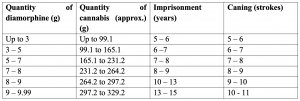


For the sake of completeness, if an individual is in possession of more than 500 grammes of cannabis, they are liable to be sentenced to death.



Source: https://www.bunburymail.com.au/images/transform/v1/crop/frm/silverstone-feed-data/e58dcde7-3ad8-4308-9fed-8bcac921e9ea.jpg/r0_0_800_600_w1200_h678_fmax.jpg


TRAFFICKING OF METHAMPHETAMINE 


The last offence is that of the trafficking of methamphetamine. If an offender is in possession of between 167 grammes to 250 grammes of the substance, they are liable to a sentencing range of a minimum sentence of 20 years’ imprisonment to a maximum term of 30 years’ imprisonment or life, alongside a mandatory punishment of 15 strokes of the cane. 


In establishing sentencing frameworks for the trafficking of methamphetamine, the Courts have extrapolated the rules of other cases, in particular
Vasentha and Suventher and applied them to cases of methamphetamine. 


In
Loo Pei Xiang Alan v PP, the Court relied on the principles established in Vasentha and derived a “conversion scale” or rather, an “exchange rate” between diamorphine and methamphetamine. In doing so, the Court explained that the Second Schedule of the MDA prescribes the exact same minimum and maximum punishments for trafficking between 10g and 15g of diamorphine and trafficking between 167g and 250g of methamphetamine. Thus, this means that, all other things being equal, an offender who traffics between 10g and 15g of diamorphine is to be considered as culpable as a person who traffics between 167g and 250g of diamorphine. Thus, the culpability of an offender who traffics one gram of diamorphine is equivalent in culpability to an identically-situated offender who traffics 16.7g of methamphetamine. In that case, the Court applied the aforementioned conversion scale and held that trafficking 11.64g of methamphetamine is an act of equivalent culpability to trafficking 0.70g of diamorphine. Upon application to the framework in Vasentha, as set out above, that quantity of diamorphine would then fall within the lower end of the lowest band of sentences, thereby encompassing quantities under 3g. Had the offender in this case been a first-time offender, the indicative starting point for trafficking 11.64g of methamphetamine would instead be five to six years’ imprisonment and five to six strokes of the cane.


On the other hand, in Adri Anton Kalangie v PP (“Adri”), the Court had extrapolated a sentencing framework for the trafficking or importation of 167g to 250g of methamphetamine from the Suventher framework and set out the following indicative starting sentences:
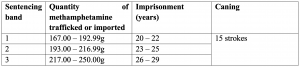


In holding as such, the Court in
Adri referred to the case of Pham Duyen Quyen v PP wherein the Court of Appeal held that the sentencing ranges for cannabis, as set out in Suventher, could also apply to offences involving other drugs where the range of prescribed punishment is the same. As the prescribed punishment for methamphetamine is the same as cannabis, the sentencing ranges could be extrapolated. 


For the sake of completeness once again, it bears reminding that if an individual is in possession of more than 250g of methamphetamine, they are liable to the death penalty. 


CONCLUDING THOUGHTS 


The Courts have made sentencing frameworks for a variety of offences, and not just the aforementioned drug offences. These frameworks are very helpful in that they allow all parties to know what the relevant starting points for the relevant offences would be. This in turn allows for greater consistency in judicial decisions which eventually allows for easier understanding of the laws surrounding drug offences in Singapore. 


Though the sentencing frameworks are helpful, one should also always note the decision in
Dinesh Singh Bhatia where the Court expressly stated that sentencing frameworks are never to be followed rigidly and there must always be some degree of flexibility. 


One should also note how the above does not take into consideration the second step of the determination of a sentence for an offender, which is the adjustment of the sentence with regard to the culpability of the offender and the presence of any aggravating or mitigating factors of the accused. Such factors differ between offenders and between cases and it is impossible to properly state how high or how low a sentence will be adjusted in light of those factors. There is thus no rule that the Court must stick within a particular band of punishment. It of course goes without saying that any punishment imposed cannot go below the relevant statutory minimums. 


In conclusion, the establishment of sentencing frameworks have been particularly helpful in the hearing of drug cases, though they are not determinative. It is entirely possible for further sentencing frameworks to be developed for other drugs or illicit substances, such as for synthetic substances.


*The views and opinions expressed in this article do not constitute legal advice and solely belong to the author and do not reflect the opinions and beliefs of the NUS Criminal Justice Club or its affiliates.

AUTHORS’ BIOGRAPHY


Mohamed Sarhan is a Year 3 Law Student in NUS Law and is one of the Project Managers of “Drugs & Forensics”. He is in charge of facilitating the activities within the project and hopes to evolve the project to a greater stage. Though still a student, Sarhan has assisted in a variety of criminal law cases and wants to use his knowledge to educate others about drug laws in Singapore. He hopes that his efforts in the project will enlighten others about the law’s position on drugs and the plight of drug offenders.



Muhammad Khairul Fikri is a Year 3 undergraduate from the Faculty of Arts and Social Sciences. Khai is one of the Project Managers of “Drugs & Forensics”. He is pursuing a Major in Geography and two Minors; Forensic Science and Geographical Information Systems. He is interested in the applications of technology, particularly geospatial technologies, in forensic science and crime scene investigations.

 

0

CJC-F, CJC-F Announcements, CJC-F Understanding Forensics, CLD Criminal Law Basics

INTRODUCTION

News reports of persons being arrested for a variety of drug offences are still common despite Singapore’s strict drug laws. Such offences include possession, consumption and trafficking of controlled drugs and substances. Sometimes, the sentences imposed by the Courts are also provided in the news report if said persons were convicted of the offences. So, you may wonder, why do some accused persons receive vastly different punishments from one another? For example, why would an accused person be sentenced to death if he was in possession of 20g of heroin but he would not if it was 20g of cannabis instead?

The reason for this is lies in the rules and limits found in the Misuse of Drugs Act (“MDA”). The MDA sets out the different drug offences that exist in Singapore and the sentence that should be imposed in accordance with the type of drug the accused person possessed.  

This article aims to introduce the offences in the MDA and the relevant sentence that an individual may receive should they be found with an illicit substance. 

Note that this article is written with reference to the newest version of the Misuse of Drugs Act, which includes the amendments made to it by virtue of the Misuse of Drugs (Amendment) Act 2019. 


SCOPE OF THE ARTICLE 

The following four basic offences will be addressed: 

  1. Possession of a Controlled Drug 

  2. Consumption of a Controlled Drug

  3. Trafficking of a Controlled Drug 

  4. Importation and Exportation of a Controlled Drug 

There are other offences in the MDA, such as the cultivation of cannabis or the abetment of any of the offences, but those offences will not be addressed in this article.  


DIFFERENT CLASSES OF DRUGS

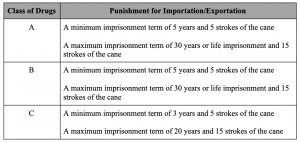
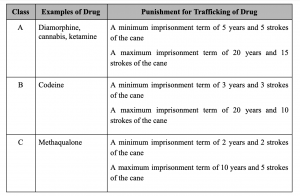
Before addressing the different drug offences, it is worth reiterating that there are countless different drugs in the world. For the purposes of conviction and sentencing, the MDA has divided the different types of drugs into Class A, Class B and Class C drugs. Different classes of drugs are subject to different possible sentences. For example, the table below illustrates how the punishment varies for trafficking different classes of drugs.


Given how vastly different the possible sentence may be according to the type of drug, the identification of the drug an accused person is found in possession of becomes extremely important. The different laboratory techniques used to identify different drugs will be discussed in subsequent articles. 


POSSESSION


Source: https://www.thejournal.ie/personal-drug-possession-poll-4753702-Aug2019/

1. Offence

The first offence is the of possession of a controlled drug or substance, as set out in Section 8(a) of the MDA and states as follows: 

Except as authorised by this Act, it shall be an offence for a person to have in his possession a controlled drug…”

2. Sentence

The sentence imposed on the offender is dependent on the type of drug found in the offender’s possession and the amount of said drug. Generally, if this was the offender’s second or subsequent offence, he may be sentenced to a minimum term of 2 years imprisonment, whereas the maximum term of imprisonment would be a term of 10 years’ imprisonment or a fine of S$20,000.00 or both.

At this juncture, it is prudent to note that the sentence imposed for cases of possession is usually dependent on the weight of the drug that was in the offender’s possession. This is addressed further below in the trafficking section. 

3. Presumptions 

The rules of possession seem quite simple as first glance as the individual only needs to be in possession of it. However, one also needs to look at the presumptions that exist in the MDA. These presumptions either (1) attribute possession of the drug to the individual, even though the individual may not be in physical possession of the drug itself (such as the drug being in his pocket), or (2) result in the offence becoming one of trafficking. 

The presumption concerning trafficking will be addressed below in the relevant section. 

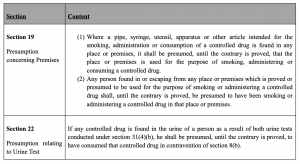
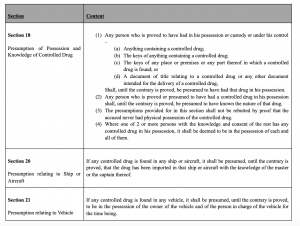
The presumptions which would attribute possession to an individual are summarised as follows:


As shown, an individual does not have to actually be holding onto the drugs itself to be deemed to be in possession of it. It is sufficient if the drugs were in the car of the person or if they were in a bag which he had thrown away. This may seem, at first glance, to be rather harsh. However, it should be noted that this is only a presumption that the drugs are in their possession. This means that if the individual can show that they did not have knowledge of the existence of the drugs, the presumption is rebutted and they will  not be guilty of an offence of possession. 


CONSUMPTION


Source: https://encrypted-tbn0.gstatic.com/images?q=tbn:ANd9GcRjWo6zWy254IDvowSFzpOD0CH_rfHhn4UmBw&usqp=CAU

1. Offence

The next offence is the consumption of a controlled drug as set out in Section 8(b) of the MDA and reproduced as follows: 

Except as authorised by this Act, it shall be an offence for a person to smoke, administer to himself or otherwise consume a controlled drug, other than a specified drug; or a specified drug”.

Put simply, it is an offence for an individual to consume a controlled drug or specified drug. This would include drugs such as cannabis or heroin. 

Another important thing to note is that this same section, and ultimately the same rules, apply even if an individual had consumed a drug overseas. Section 8A of the MDA section sets out how a Singapore citizen could still be charged with an offence, even though he committed the offence overseas. Note that this still applies even though it may be legal to consume the drug overseas. For example, it is legal to consume cannabis in some states in the United States. That act still does not exempt you from being convicted of a consumption charge here despite having consumed said cannabis in a country where it is legal. 

2. Presumptions 

Just like for possession, the offence of consumption is also subject to certain presumptions:


The above presumptions can be rebutted with proof of the contrary. For example, some legal medicines, when consumed, may result in a reaction in the body similar to drugs like methamphetamine. This is why you are usually required to declare whether you are on any medication before any urine tests – in case there is a false positive.


3. Sentence 

The starting point for consideration of the sentence to be imposed for consumption cases is imprisonment of a minimum of one year to a maximum of 10 years, set out in Section 33(3A) of the MDA, reproduced as follows: 

Any person convicted of an offence under section 8(b), 31(2) or 31A(2) that is committed on or after the date of commencement of section 16 of the Misuse of Drugs (Amendment) Act 2019 shall on conviction be punished with imprisonment for a term of not less than one year but not more than 10 years and shall also be liable to a fine not exceeding $20,000, unless the person is punished under subsection (4), (4AA) or (4AB) or section 33(A) (as the case may be) for that same offence.


As evinced from the aforementioned section, the position of sentencing is dependent on whether the person is punished under other subsections of Section 33. This includes factors such as prior convictions of similar offence, the failure to provide a specimen of urine for a urine test and previous admission in a drug rehabilitation institution. 

Hence, it can be said that the sentence to be imposed on a drug offender is dependent on the prior record of the said offender.


TRAFFICKING


Source: https://www.footprintsbeachside.com/blog/drug-trafficking-addiction-in-florida/

1. Offence

The third offence is that of trafficking of controlled drugs, which is set out in Section 5 of the MDA and reproduced as follows: 

(1) Except as authorised by this act, it shall be an offence for a person, on his own behalf or on behalf of any other person, whether or not that other person is in Singapore – 

(a) To traffic in a controlled drug; 

(b) To offer to traffic in a controlled drug; or 

(c) To do or offer to do any act preparatory to or for the purpose of trafficking in a controlled drug. 


(2) For the purposes of this Act, a person commits the offence of trafficking in a controlled drug if he has in his possession that drug for the purpose of trafficking. 

The term ‘traffic’ is also defined in Section 2 of the MDA to mean: 

(a) To sell, give, administer, transport, send, deliver or distribute; or 

(b) To offer to do anything mentioned in paragraph (a)

Otherwise than under the authority of this act, and “trafficking” has a corresponding meaning. 

From the aforementioned definition, the scope as to what constitutes ‘trafficking’ is rather large. This essentially means that if Person A carries a packet of heroin from his house to Person B’s house, it is technically trafficking as he is transporting or delivering said packet to Person B’s house. 

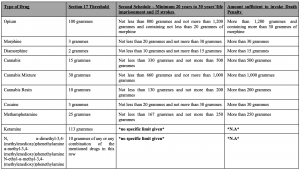
Apart from fulfilling one of the acts of trafficking set out in Section 2 above, an accused person may also be charged with trafficking if they are in possession of an amount of that particular drug that is above a particular threshold. This is as set out in Section 17 of the MDA which specifies the minimum statutory thresholds that, if crossed, would mean that a person is found to be in possession of the drugs for the purposes of trafficking. If the amounts are crossed, it is presumed that the individual is in possession of the drugs for the purposes of trafficking. 

For the avoidance of doubt, if the individual is in possession of an amount of the drug which is less than the amount set out in Section 17, then he would only be considered to be in possession of said drug, unless he is actually trafficking it, as per the Section 2 definition.  

2. Sentence 

For sentencing in trafficking cases, the weight of the drug is paramount. Once the weight of the drug is found to be above a certain weight threshold, the individual may be sentenced to death. The table below sets out the different statutory limits that the MDA has placed on certain drugs. These drugs are those specifically flagged out in the MDA to have their own specific limit, which if crossed, converts the offence of possession to that of trafficking. 

If the amount being trafficked is within a particular range, as set out below, the accused person would be subject to a sentence in the sentencing range of the statutory minimum of 20 years’ imprisonment, and 15 strokes of the cane, and the statutory maximum of 30 years or life imprisonment, along with 15 strokes of the cane. 


IMPORTATION AND EXPORTATION OF A CONTROLLED DRUG

Source: https://www.europol.europa.eu/newsroom/news/international-drug-trafficking-network-disrupted

1. Offence 

The last offence to be addressed presently is that of importation and exportation of controlled drugs. This is as set out in Section 7 MDA which states:
 

Except as authorised by this Act, it shall be an offence for a person to import into or export from Singapore a controlled drug.

The offence is made out if an individual brings drugs in or out of the country. For the avoidance of doubt, the individual must have had knowledge of the drugs.

2. Sentence

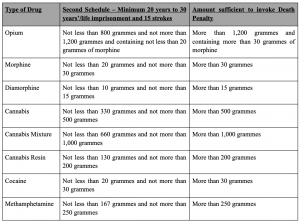
The sentence is dependent on the weight of the drugs that were being imported or exported. Offences of importation and exportation are generally deemed to be more serious than that of trafficking, and this is reflected in the Second Schedule of the MDA which provides that the general maximum imprisonment term is that of 30 years. Note that the death penalty may also be imposed if the amount of drugs involved in the charge is higher than the threshold set out in the MDA. 

The general sentencing ranges for offences of importation or exportation differs depending on the class of drug being imported or exported, and is as follows:

The vast difference in the general sentencing ranges between trafficking and importation shows how such offences of importation and exportation are seen as more serious offences than that of trafficking. 

The table below summarises the basic sentences that will be imposed for the offences of importation or exportation of certain drugs:


CONCLUSION 

Apart from the above mentioned offences of possession, consumption, trafficking and importation/exportation of drugs, there are far more offences in the MDA which are beyond the scope of this article. This article seeks to help readers understand the basic drug laws that exist in Singapore.


*The views and opinions expressed in this article do not constitute legal advice and solely belong to the author and do not reflect the opinions and beliefs of the NUS Criminal Justice Club or its affiliates.

AUTHORS’ BIOGRAPHY

Mohamed Sarhan is a Year 3 Law Student in NUS Law and is one of the Project Managers of “Drugs & Forensics”. He is in charge of facilitating the activities within the project and hopes to evolve the project to a greater stage. Though still a student, Sarhan has assisted in a variety of criminal law cases and wants to use his knowledge to educate others about drug laws in Singapore. He hopes that his efforts in the project will enlighten others about the law’s position on drugs and the plight of drug offenders.


Muhammad Khairul Fikri is a Year 3 undergraduate from the Faculty of Arts and Social Sciences. Khai is one of the Project Managers of “Drugs & Forensics”. He is pursuing a Major in Geography and two Minors; Forensic Science and Geographical Information Systems. He is interested in the applications of technology, particularly geospatial technologies, in forensic science and crime scene investigations.
 

0


An ongoing spate of sexual or violent offences committed by university students have put Singapore’s judicial system under the spotlight. Uncharacteristically vocal in their displeasure with the criminal sentencing and judicial reasoning for these cases, the frequent invocation of the “bright” or “promising future” mitigation plea has left the community angered. 

Singapore’s criminal justice system has undergone an evolution of sorts. From our mandatory death penalty laws taking on a discretionary nature to amendments to the Misuse of Drugs Act emphasising the rehabilitation of recalcitrant offenders, we are seeing long-standing criminal justice principles such as retribution and deterrence being increasingly counterpoised by rehabilitation. It is against this backdrop that we must assess the defensibility of the “promising future” mitigation plea.


Criminal justice, mitigation pleas and sentencing in Singapore


Singapore’s criminal law is largely statutory in nature, where most offences are codified in the Penal Code and other statutes such as the Misuse of Drugs Act and Vandalism Act. Following an offender’s conviction, the penalties imposed could range from a fine, imprisonment, caning, reformative/corrective training or community service, or a combination thereof. 

Though judges are statutorily bound by the upper and lower limits stipulated in the relevant Acts and Codes along with guidance by the reasoning and sentencing benchmarks laid out by past judges, they do possess some latitude and discretion whilst passing sentences. Sentences may be lengthened or lightened by aggravating and mitigating factors respectively, with the latter being enclosed within defendants’ mitigation pleas. Mitigation pleas are regularly heard in most jurisdictions and aid the law in striking an equilibrium between rehabilitating the perpetrator with the eventual goal of re-integrating him back into society and punishing him as a deterrence from committing crime.


An analysis of the “promising future” mitigation plea

Despite only recently making headlines, our research has revealed that the “promising future” plea has in fact been heard since 1995. This strategy attempts to highlight a defendant’s favourable future prospects to persuade the court to exercise leniency in its sentencing. Contrary to popular belief, cases seeing the invocation of “promising future” are not limited to sexual offences; they run the gamut, from extortion and forgery to negligence and drug consumption. 

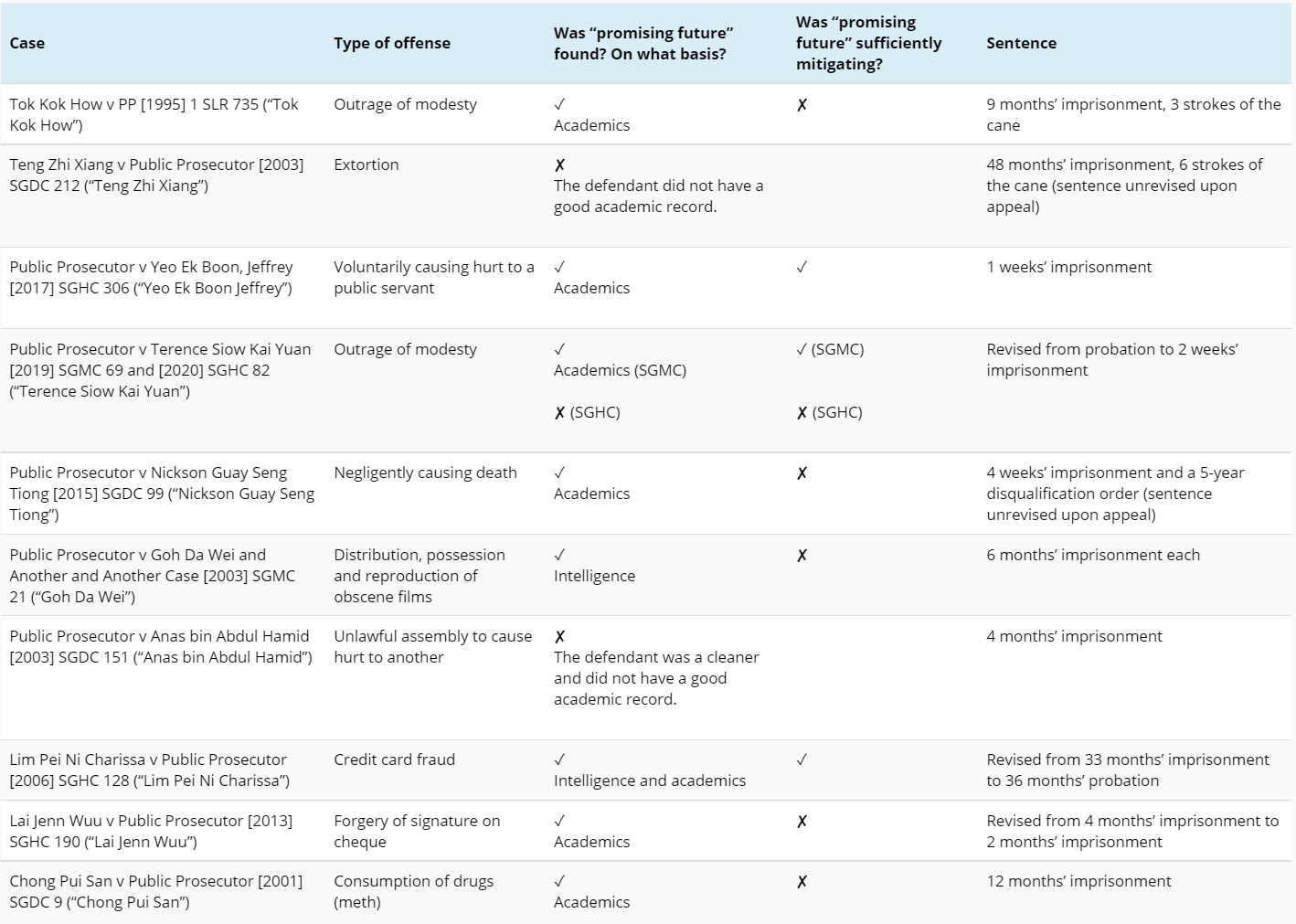
The table below showcases some instances where the “promising future” plea was invoked:


At this juncture, it is apposite to note that promising future pleas are sometimes advanced alongside other mitigating factors and may work in tandem to produce the observed effect (viz. more lenient sentences). Therefore, this analysis does not purport to be an empirical inquiry into how such pleas quantitatively affects courts’ sentencing decisions; it is instead merely illustrative of what a “promising future” broadly entails in the eyes of the law, as evinced by case law. It is also important to note that promising future pleas seem to fail more often than they succeed, though their efficacy is invariably linked to the severity and nature of the offence committed. 

Across all cases, it appears that courts perceive a defendant’s academic performance to be indicative of his or her “promising future” (or lack thereof). Such accused are often in the course of furthering their tertiary studies and have attained sufficiently good results. For example, particular attention was accorded to the defendant’s “excellent academic and extra-curricular record” in Tok Kok How, the “good grades” that the defendant was projected to achieve upon graduation in Chong Pui San, and the scholar status of the defendant in Nickson Guay Seng Tiong.

Most recently and controversially, the Magistrates’ Court in Terence Siow Kai Yuan seemingly accepted the defendant’s submission that, inter alia, his “[g]ood academic performance in school highlights his potential to excel in life” (though the High Court subsequently rejected this contention). This may suggest a conflation of past and projected academic performance with the degree of promise in one’s future; which is further buttressed by the holding in Anas bin Abdul Hamid and Teng Zhi Xiang, the only two cases where promising future was not found. In Anas bin Abdul Hamid, the promising future plea was rejected as the accused was “not a student with an excellent academic record”. He had only studied up until Secondary 2 and was working as a “cleaner” at the time of the offence. In Teng Zhi Xiang, the accused had only enrolled as a student in the Orchard School of Arts & Commerce recently, and did not possess “an exceptionally good academic record that warranted the court to exercise its discretion to call for a pre-sentence report”.

Courts have also placed some emphasis on the defendant’s chosen course of studies and desired career. They noted that the defendants in Lim Pei Ni Charissa and Lai Jenn Wuu were respectively pursuing courses in “Law and the Arts” and “Medicine”, and that the defendant in Nickson Guay Seng Tiong was an “entrepreneur” and “scholarship holder”. Contrasted to their remarks about the defendant in Anas bin Abdul Hamid, this may be suggestive of an elitist or technocratic approach towards the finding of a “promising future”.

However, this assertion should retrospectively be repudiated, as the promising future plea was recognised for most defendants (though it was still pleaded with varying degrees of success) who were enrolled in a rather diverse range of courses and institutions. Amongst these were the National University of Singapore, LASALLE College of the Arts, the Singapore Institute of Commerce, the University of Western Australia and “a university in the People’s Republic of China”. Therefore, it would be erroneous to accuse courts of only finding “promising futures” for certain defendants pursuing certain academic courses at certain tertiary institutions – as netizens have been wont to do as of late – as the case law simply does not support such a claim. 


Worryingly, there may be an even more fundamental and insidious assumption at play here. Though the court in Tok Kok How did allude to defendant’s non-academic record by way of his extracurriculars and distinction in National Service, it is indisputable that, at least up until the High Court’s judgement in Terence Siow Kai Yuan, it is generally academic performance that occupies the forefront of the court’s mind when they are tasked with ascertaining if a “promising future” exists. This dangerously conflates one’s academic potential with the potential in their character, with the latter forming the “true” and more appropriate justification for a lightened sentence. While intelligence, education level and academic performance may serve as rough proxies for gauging “promise” and potential, it is fallacious to regard these factors as indicative of an offender’s remorse, propensity for reform, and/or deservingness of a lighter sentence. The correlation between one’s academic ability and “promising future” (or lack thereof) is tenuous at best.


Recent controversy

As previously alluded to, there has been a great deal of controversy and frustration with regard to the pleading of “promising future”. The recent cases of Yin Zi Qin and Terence Siow Kai Yuan Siow speak volumes about the general public sentiment that guilty parties invoking this defense have allegedly escaped with a slap of the wrist. For example, at least 133000 people endorsed a petition denying favourable sentences for “educated” sex offenders while 21000 people endorsed a petition requesting for Yin Zi Qin to receive a harsher punishment. For Terence Siow Kai Yuan, the Law Minister himself expressed his surprise at the light sentence imposed by the District Court judge. Even the PAP Women’s Wing, part of the ruling party that has been known not to comment on rulings in court cases, disseminated a statement stating that they were “dismayed” by the light sentence given to Yin Zi Qin.

In a time where perpetrators of sexual crimes are increasingly and rightfully being held accountable, spurred by the #MeToo movement that brought sexual harassment and assault crimes to the fore, it is unsurprising that there is growing discontent that the “promising future” mitigation plea seemingly allows offenders to evade liability. However, our analysis seeks to dispel some of these misconceptions. 

Firstly, it is undeniable that the first-instance sentences of both cases (probation and community service for Siow who had outraged a victim’s modesty, and detention and community service for Yin who had voluntarily caused hurt by strangling a victim) were manifestly inadequate. Upon appeal, the High Court judges had conceded as much, prompting a revision in sentencing. The true issue is whether having a “promising future” or good academic performance (as courts ostensibly treat the two as interchangeable) had caused or influenced the respective Magistrates’ Court and District Court judges to pass excessively lenient sentences – this would be problematic as it suggest that victims would receive different forms/amounts of justice depending on how academically-inclined their perpetrators are. However, there is no conclusive evidence to suggest this has happened.

When heard before the Magistrates’ Court, the judge did equate Siow’s strong academic record with his “potential to excel” and propensity to reform. However, she also outlined the following factors that warranted rehabilitative sentencing for Siow: 

  1. The positive reports from his school and NS supervisors demonstrated that he could behave with proper guidance
  2. The offence was ad-hoc in nature
  3. He was impaired when he committed the offence
  4. He pled guilty at earliest time and was cooperative during investigations
  5. He showed remorsefulness
  6. He was aware that he had a problem, and demonstrated a desire and willingness to change


This suggests that even though judges do assess the degree of promise or potential in one’s future by their academic performance, they also consider many other mitigating factors (albeit not under the term “promising future”). It is unlikely that any single factor is determinative of the eventual sentence. Therefore, it would not be entirely accurate to attribute Siow’s relatively lenient first-instance sentence solely to his academic record or “promising future” mitigating factor – it is more probably that the judge took all the relevant factors into account and exercised her discretion to arrive at the final sentence.

Upon appeal, Terence Siow Kai Yuan Siow was heard before the High Court, where Menon CJ directly addressed the controversy regarding the “promising future” plea. He highlighted Praveen s/o Krishnan v Public Prosecutor [2018] 3 SLR 1300 where Steven Chong JA opined:

[T]he quest for academic qualifications is merely one indicator of rehabilitative capacity. Although it usually helps that young offenders are good students as it stands them in better stead and fortifies their chances of reform… the issue is not ultimately whether the offender is academically promising. Rather, the relevant question is whether he has demonstrated a positive desire to change and whether there were conditions in his life that were conducive to helping him turn over a new leaf. In this regard…, scholastic mediocrity or the fact that the offender is no longer in school should not be reasons by themselves to conclude that the offender is incapable of rehabilitation. Other avenues, such as vocational training or employment, would also be pertinent in assessing the offender’s prospect for reform.  


Here, Menon CJ is ostensibly cautioning judges against placing excessive emphasis on the mitigating nature of good academics. To reconcile the different approaches that he acknowledged that different judges were utilizing, Menon CJ outlined a new multifactorial approach to determine the rehabilitative prospects of an individual that encompasses the previously used approaches. Under his three-limbed framework, courts should sequentially determine whether (1) the offender has demonstrated a positive desire to change, (2) there are conditions aiding the offender to turn over a new leaf and (3) there are risk factors that warrant the court to not find a high propensity for reform. Therefore, an offender’s scholastic evidence would be “irrelevant, unless a link can be drawn between the offender’s scholastic excellence and the offender’s rehabilitative capacity”. 

Applying this framework to Terence Siow Kai Yuan Siow, Menon CJ considered, inter alia, whether Siow was truly remorseful, whether he had undertaken measures to curb his pornography consumption, and whether he would receive adequate familial support. He did not consider or mention Siow’s academic record.  

On re-examination, while public perception often elevates “promising future” to be the dispositive and make-or-break factor in lenient sentencing, the first instance judge’s consideration of other mitigating factors and Menon CJ’s proposed multifactorial approach in Terence Siow Kai Yuan Siow both tacitly acknowledge that academic results are not the sole consideration in assessing whether rehabilitation is an appropriate sentence for an offender. The public outrage that sexual offenders escape with a slap on the wrist as a result of having good grades and a “promising future” may have been overblown. 


Issues


As suggested previously, the High Court’s holding in Terence Siow Kai Yuan Siow may redirect and reorientate lower courts to more holistically assess whether a defendant truly possesses a “promising future” as opposed to a mere “promising academic future”. Nevertheless, the method adopted by Menon CJ also raises further questions: 

  1. Should “promising future”/good academics be a risk factor and not a mitigating factor?

Menon CJ viewed strong academics as an irrelevant consideration unless they evince an offender’s rehabilitative capacity. However, could there be instances where strong academics point against one’s propensity to reform, or constitute aggravating or risk factors instead? In foreign jurisdictions such as several US states, offenders’ high intelligence levels are often looked upon neutrally or even unfavourably as they arguably increase an offender’s moral blameworthiness. For example, the Supreme Court of Arizona in State v. Henry, 944 P.2d 57 (Ariz. 1997) saw “no reason to reward an individual who uses his education and intelligence in duplicitous ways.”

  1. Should sexual offences fall under the ambit of offences where rehabilitation should be considered as a sentencing principle?

There have been calls to completely disallow rehabilitative sentences for offences of a sexual nature. However, this is extremely unlikely as courts have long abstained from imposing blanket rules on any kind of offence. This is because the facts surrounding each offence differs from another with regards to their nature, surrounding circumstances or antecedent events. When determining whether rehabilitation is suitable for a particular offender, courts assess offender-specific factors as well as offence-specific factors, including the mens rea, actus reus and general egregiousness of the offence; some offenders may have simply been less culpable and blameworthy so as to warrant a rehabilitative sentence. Therefore, courts will definitively retain rehabilitation as a possible sentence for sexual offenders as judges’ powers of discretion enable them to match the severity of the sentence to that of the offence.


The way forward

In conclusion, it is likely that an offender’s “promising future” or strong academics will play a far less significant role in future sentencing decisions, which may, in turn, reduce the chances of sentences passed being inadequate. However, in the learned words of the former CJ Chan, “sentencing is not an exact science, and is essentially a matter of discretion and judgment call”. There will inevitably be sentences perceived to be overly lenient, and sentences perceived to be overly punitive. 

As civilians, how should we best respond to perceived injustice when it arises? In light of recent events, there is a need to stress that internet vigilantism such as doxxing and harassment often lead to counterproductive outcomes. Instead, more effective methods of response may include personally reading the judgements of allegedly unjust cases to glean a better understanding of the judicial reasoning behind the sentence passed, engaging in reasonable and responsible modes of civic participation such as writing in to MPs and the Straits Times forum, as well as holding constructive discussions with those around us. 


Benjamin Goh and Tan Ying Qian

*The views and opinions expressed in this article do not constitute legal advice and solely belong to the author and do not reflect the opinions and beliefs of the NUS Criminal Justice Club or its affiliates.
0